

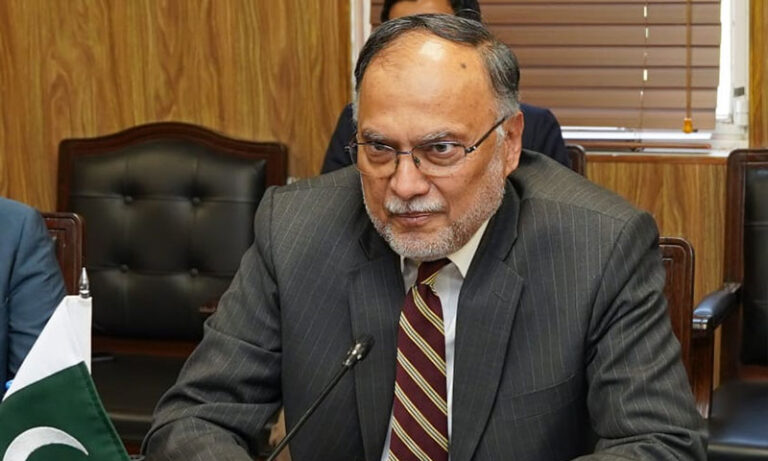

Federal Minister for Planning Ahsan Iqbal has said Pakistan and China have entered a new era of technological partnership following the successful participation of Pakistani astronaut Zeeshan Ali in the Shenzhou-24 mission, with plans to train 10,000 PhD scholars at leading Chinese universities over the next decade.
Ahsan Iqbal was addressing a press conference at the Pakistan Embassy in Beijing after the launch of the Shenzhou-24 mission. He said Pakistan had earned the distinction of becoming China’s first international partner in a manned space mission, while Zeeshan Ali had become the first international visitor to the Chinese space station. He thanked Chinese President Xi Jinping, the Chinese government, the China Manned Space Programme and the people of China for the opportunity.
Describing the achievement as a sign of the deep friendship between the two countries, the minister said the partnership had now moved beyond the skies into space. He said the collaboration had opened another dimension of the relationship and that space technology had become essential for nations pursuing sustainable development and economic competitiveness. “This is not the finish line. It is the beginning of a new partnership,” he said.
Space Technology To Help Pakistan Face Climate Risks
Ahsan Iqbal said Pakistan ranks among the ten most climate vulnerable countries in the world and has faced devastating climate related disasters, particularly in 2022 and 2025. He said satellite technology can improve disaster preparedness, early warning systems, emergency response and relief work, and can also help with food security, water management, urban planning, logistics and connectivity. He stressed the need to modernise agriculture through climate resilient seeds, efficient irrigation and better management of water resources, and described water security as an increasingly critical national concern after India’s unilateral suspension of the Indus Waters Treaty.
Lunar Landing Target Set For 2035
The minister reaffirmed the government’s commitment to accelerate Pakistan’s space programme, noting that the country has launched about five satellites over the past two years. He said Pakistan aims to take part in an upcoming lunar mission by sending a rover to the Moon, paving the way for a lunar landing by 2035, and will benefit from China’s technological expertise rather than developing every capability on its own.
Under the proposed Knowledge Corridor initiative, Pakistan aims to have at least 10,000 PhD scholars trained at leading Chinese universities over the next decade in artificial intelligence, space sciences, biotechnology, materials science, big data, automation and robotics.