
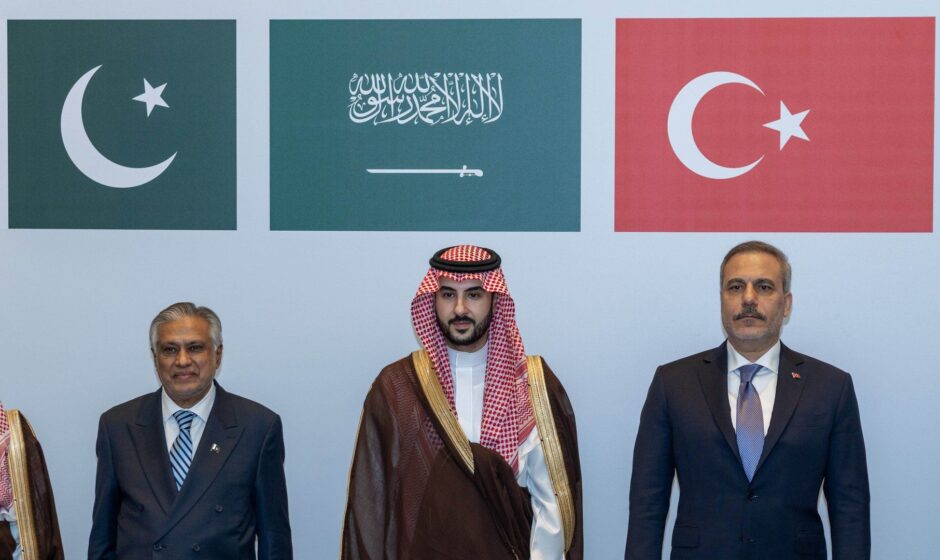

Pakistan, Saudi Arabia and Turkiye reaffirmed their collective defence commitment on Friday at the second meeting of the Strategic Political and Defence Committee of the Makkah Alliance for Defence in Islamabad.
In a joint statement, the three countries strongly condemned persistent attacks by the Houthi militia targeting civilians and civilian infrastructure in Saudi Arabia. They reaffirmed their collective resolve to support the Kingdom in safeguarding its security, sovereignty and territorial integrity under the collective defence provisions of the Makkah Joint Defence Agreement.
The committee praised the pace of progress towards establishing and operationalising the alliance secretariat in Saudi Arabia, describing it as an important part of the alliance institutional work and effective coordination among its members.
Stronger defence cooperation
The three sides agreed to strengthen cooperation in defence industries, joint technological development, military training and capacity building, with the aim of enhancing the collective capabilities and cohesion of their armed forces.
Prime Minister Shehbaz Sharif joined senior Saudi and Turkish officials at the meeting in a show of unity. Deputy Prime Minister and Foreign Minister Ishaq Dar briefed the media after the meeting, which brought together the foreign and defence ministers and military chiefs of the three countries. The Saudi delegation was led by Defence Minister Prince Khalid bin Salman, and the Turkish delegation included Foreign Minister Hakan Fidan. Turkiye will host the next meeting of the committee.
Pakistan, Saudi Arabia and Turkiye signed the Makkah Joint Defence Agreement on August 7, establishing a framework for closer military cooperation centred on the principle that an armed attack against one member would be considered an attack against all. The committee held its first meeting in Istanbul on August 31 and an emergency meeting in Riyadh on October 5. The meeting announced no new military deployment or joint operational command, with the focus remaining on institutionalising the alliance.