

Prime Minister Shehbaz Sharif and Chief of Defence Forces and Chief of the Army Staff Field Marshal Syed Asim Munir spoke live on Saturday with Pakistani astronaut Zeeshan Ali aboard China’s Tiangong space station, in a call made from the headquarters of the Space and Upper Atmosphere Research Commission in Islamabad.
Ali became the first Pakistani in orbit on Wednesday, when he also became the first foreign astronaut to board the Tiangong space station. The 40 year old pilot is serving as a payload specialist on the Shenzhou 24 mission and is set to stay at the station for five to ten days, carrying out scientific research alongside his Chinese crewmates.
Speaking first during the call, which was aired on media channels, the prime minister said it was a great day for all those present and for 240 million people of Pakistan, and he extended his warmest felicitations to Ali on becoming the first Pakistani astronaut to orbit the Earth. He was accompanied by Field Marshal Munir, Deputy Prime Minister and Foreign Minister Ishaq Dar, and China’s Ambassador Jiang Zaidong.
The prime minister recited a couplet of Allama Iqbal and said Ali’s success had ignited a renewed spirit of ambition in a generation eager to push boundaries and explore new frontiers. He said the ties between Pakistan and China, already described as higher than the Himalayas and deeper than the ocean, had now soared beyond the skies, and he thanked President Xi Jinping for taking the all weather strategic cooperative partnership to unprecedented heights.
Field Marshal Munir told Ali that the nation was really proud of him and proud of the armed forces that one of their own had gone into space. He said Ali’s presence aboard the Chinese space station was a proud testament to the time tested strategic partnership, and he described the friendship with China as higher than the Himalayas, deeper than the oceans, sweeter than the honey, and now boundless as the universe.
A message for the youth
Responding to them, Ali said it was a great honour to represent Pakistan 400 kilometres above the Earth, orbiting at 7.9 kilometres per second, as the first astronaut from the country to orbit the Earth and the first international astronaut to enter the Chinese space station. He said everything was going very well and according to plan, and he was doing his best to perform his duties and the scientific research work as per the expectations of the entire nation.
In remarks addressed to the Pakistani youth, Ali urged them to promote education and to excel in science and technology. He said he hoped the next generation of astronauts, engineers and scientists would travel even farther into space and explore further for the betterment of humanity.
The prime minister said Ali represented the beginning of Pakistan’s manned missions into space, and the knowledge he brings back will open a very important chapter in Pakistan’s pursuit of excellence in science and technology and other related fields. He added that outer space should serve peaceful purposes and the collective wellbeing of all humanity, and the experiments Ali is conducting with his Chinese colleagues will enrich the collective scientific knowledge of the international community.
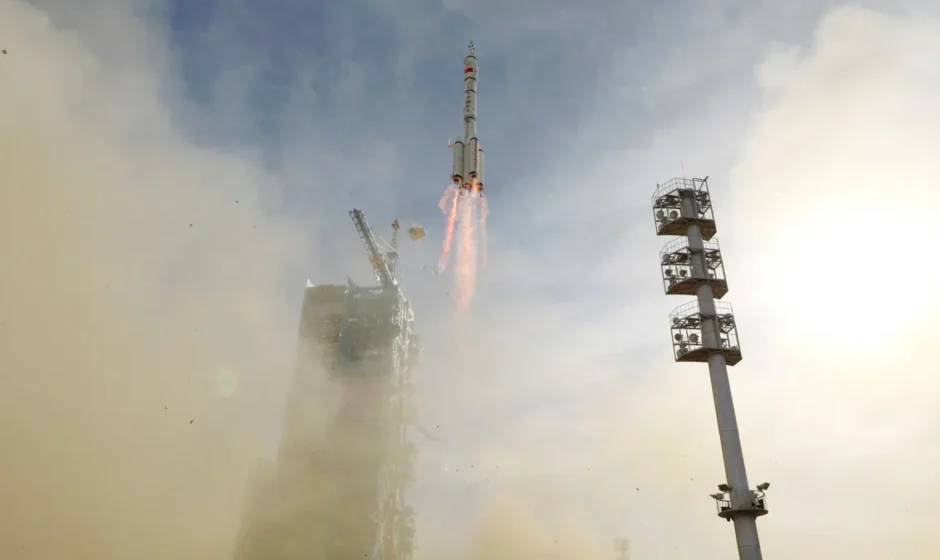
The Shenzhou 24 crew, comprising Chinese commander Tang Hongbo, flight engineer Wu Yi and Ali, docked with Tiangong three hours and 38 minutes after a Long March 2F rocket lifted off from China’s Jiuquan Satellite Launch Centre. During the mission, Pakistani scientific payloads will be deployed in the Wentian and Mengtian laboratories, including cultivating microalgae as a potential source of food and oxygen for future space missions and studying the effects of spaceflight on quinoa seeds. The crew will conduct around 90 experiments in total.
Ali and Khurram Daud were chosen from Pakistan in April to start training in China, under a cooperation agreement signed by Suparco and the China Manned Space Agency in February 2025. Speaking at a press briefing in Jiayuguan on Tuesday, Ali said he was deeply grateful to the Chinese government for helping Pakistan realise its dream of going into space, and he said the mission was not a finish line but a launch pad, with hopes of growing from one astronaut and one flight to multiple joint flights, to the Moon, Mars and beyond.